Campus Security Camera Program Update
On October 27, 2026, EVPT Glen Shor, who oversees the Office of Public Safety and Information Systems and Technology (IS&T), provided the following summary to the MIT community about campus security cameras.
MIT’s administration is responsible for protecting campus safety and property, and we consider the existing security camera program to be an important tool in support of our efforts.
In the spring and fall of 2026, I have provided updates about MIT’s security camera program at Institute faculty meetings and in an online FAQ. In parallel, I sought community feedback about whether we might consider incorporating limited AI capabilities into the program. During these discussions, we heard significant questions about even limited use of AI in this context. Given the complexity of the issues raised, we have decided not to proceed.
We are thus maintaining the existing security camera program as it operates today – with no AI, no audio recording, and no facial recognition.
“No AI” means that we do not use AI to monitor or analyze campus activity, and that we will not continue to explore the possibility of adopting limited AI capabilities.
Below we provide background about the existing campus security camera program, including recent camera additions, and our decision on AI.
Campus security camera program background
MIT has long had a security camera program. Alongside building access controls, emergency preparedness training and planning, and other measures, the security cameras help keep our community safe and our campus secure, a core responsibility of the administration.
Security camera footage helps the MIT Police understand and resolve safety issues and incidents such as theft, vandalism, and property damage that occur across our 168-acre campus and 13.8 million gross square feet of campus buildings. Given the volume of calls to the police about such issues, we need to rely on standard campus safety tools like security cameras in order to properly respond.
MIT Police dispatchers are able to review footage on a real-time basis after a call reporting an incident, to help assess what response, if any, makes sense. MIT Police detectives are also able to review the footage during investigations after reported incidents to better understand these incidents and determine appropriate next steps.
The Institute’s security camera program and related policies are governed by the following strict guardrails:
- We do not conduct surveillance, by which we mean: MIT Police do not proactively monitor security footage on a real-time basis except in very limited circumstances (e.g., for large events such as Commencement, and to monitor the Nuclear Reactor Laboratory, as required by law).
- The security cameras do not record audio, use facial recognition, or leverage AI in any way to observe or analyze campus activity.
- MIT does not record security camera footage where community members have a reasonable expectation of privacy. Dormitory rooms, bathrooms, locker rooms, medical exam rooms, and similar locations are off limits.
- Security camera footage is stored in IS&T’s secure, on-site data storage center and generally retained for 30 days unless it is necessary to preserve certain footage in connection with a specific investigation, incident, or legal requirement.
- Security camera footage can be shared with the Committee on Discipline (COD) for student disciplinary purposes with the written approval of a senior officer. The use of such footage in student disciplinary proceedings is rare. IS&T policy language was recently clarified without changing this longstanding rule and practice.
Recent security camera expansion
We have periodically updated our security camera set up to ensure we maintain appropriate coverage of campus property. The need increased significantly because, over the past decade, our MIT 2030 capital program added 1.1 million gross square feet of buildings requiring additional coverage.
We have also added specific cameras as we have become aware of blind spots in priority spaces. Over the past year, we installed 575 additional security cameras in public, high-traffic spaces in the Main Group, on the exterior of certain buildings, and on certain outdoor fixtures (e.g., emergency phones). This effort closed gaps in coverage that became apparent during investigations of acts of vandalism, theft, and property damage.
While these incidents drew our attention to these blind spots, we were primarily concerned with ensuring adequate coverage in the case of a more serious safety-related event, particularly in high-traffic areas that could be targeted – and for which we might otherwise struggle to have clear sight lines during a campus emergency.
In keeping with standard protocol for augmenting our security camera set up, the Campus Safety Working Group, which includes representatives from the MIT Police, IS&T, Campus Planning, and the Provost’s Office, reviewed the addition and placement of these cameras. IS&T’s budget covered all associated costs – we did not make cuts to other unit budgets or campus priorities to fund this project. And the newer cameras are used in the same way as previously installed cameras: to shed light on issues brought to the MIT Police’s attention, with no use of AI, no audio recording, and no facial recognition.
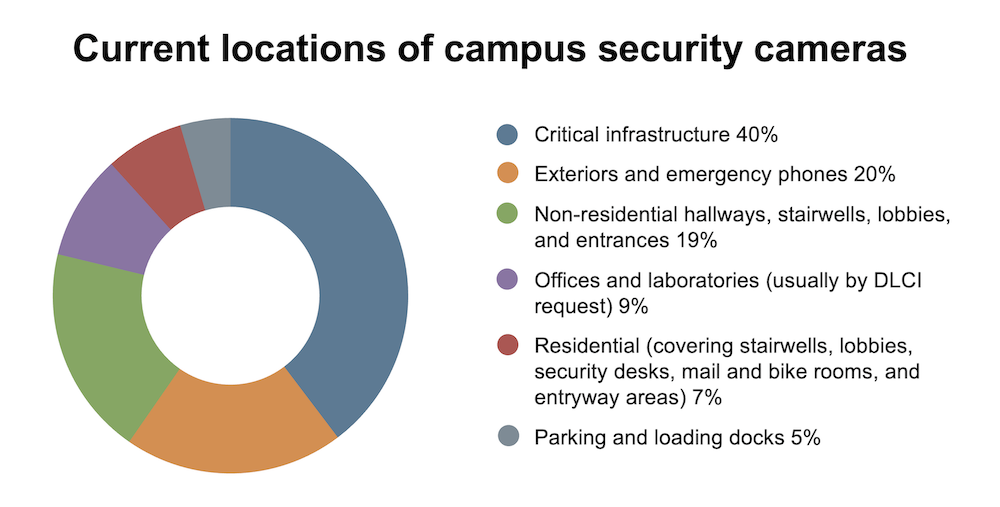
As illustrated below, 60% of our approximately 4,600 campus security cameras are located in critical infrastructure and exterior locations. Examples of critical infrastructure locations include the Central Utilities Plant, police station, Nuclear Reactor Laboratory, and telecommunications and data rooms across the campus overseen by IS&T.
Over the summer of 2026, we established a group of faculty, staff, students, and postdocs to consider whether AI could potentially be deployed to:
- enable more efficient review of camera footage during investigations; and
- identify significant safety events – such as someone brandishing a firearm or leaving an unattended package in a highly trafficked public space – on a real-time basis.
The group’s discussion was informed in part by findings from a time-bound pilot we conducted under a limited agreement with Ambient.ai. This pilot included using staged scenarios to explore how real-time alerts could work for specific safety events. The pilot has concluded, and all data has been purged from Ambient.ai’s portal.
After reflecting on feedback received from the advisory group as well as a cross-section of community members, we have decided to stop our evaluation of the limited use of AI in MIT’s security cameras and have no plans to revisit the issue. The potential change raised complex issues that led us to conclude we should not proceed further on this front.